Strategic Delegation: How Delegating Tasks Can Transform Productivity and Planning
Delegating tasks is more than just assigning work to others—it’s a deliberate strategy that, when executed well, can enhance productivity, improve communication, and support long-term business goals. Whether you're a solo entrepreneur, a small business owner, or part of a larger team, understanding how to delegate tasks effectively is a core competency that separates good leaders from great ones.
At its core, Delegating Tasks involves transferring responsibility for specific activities to another person while maintaining accountability for the outcome. It’s not about offloading work indiscriminately but about matching the right tasks to the right people at the right time. This strategic alignment can free up mental space, reduce bottlenecks, and empower team members to grow professionally.
Why Delegating Tasks Matters for Strategic Planning
When you delegate tasks with intention, you’re not just managing work—you’re shaping how your team operates and how your business evolves. Delegation becomes a tool for planning rather than a reaction to being overwhelmed. It allows leaders to focus on high-level thinking, strategy, and innovation, knowing that operational tasks are being handled by capable hands.
For example, a content creator who delegates routine tasks like social media scheduling or email list management can redirect their energy toward developing new content ideas or refining their brand strategy. This shift not only improves output quality but also aligns daily operations with long-term goals.
Delegating Tasks as a Communication Tool
Effective delegation requires clear communication, which in turn strengthens team dynamics. When you delegate a task, you’re essentially outlining expectations, setting boundaries, and opening a channel for feedback. This process builds trust and clarity, both of which are essential for maintaining a cohesive team culture.
Consider a project manager who delegates a client onboarding process to a new team member. By clearly defining the steps, desired outcomes, and available resources, the manager not only ensures the task is completed well but also helps the team member understand their role within the broader customer experience.
When to Delegate and What to Consider First
Knowing when to delegate tasks is just as important as knowing how. Delegation should be a strategic decision, not a last-minute reaction. Here are some key considerations before assigning a task:
- Is the task repeatable? If a task occurs regularly, it’s often a good candidate for delegation.
- Does it align with someone else’s strengths? Matching tasks to skills increases efficiency and job satisfaction.
- Can it be documented? Well-documented processes make delegation easier and reduce the need for constant oversight.
- Is the timing right? Delegating during high-pressure moments can lead to confusion or errors.
These questions help ensure that delegation supports both immediate needs and long-term operational health.
Practical Examples of Delegating Tasks in Real Business Scenarios
Let’s look at a few real-world applications of strategic delegation:
- A small business owner delegates daily customer support inquiries to a virtual assistant, allowing them to focus on product development and marketing strategy.
- An educator delegates the creation of course materials to a teaching assistant, using their expertise to guide the structure while freeing up time for student engagement.
- A freelance designer outsources file organization and asset tagging to a junior designer, enabling them to meet tight deadlines without sacrificing quality.
In each case, the act of delegating tasks wasn’t just about workload—it was about optimizing resources and aligning team strengths with business priorities.
The Role of Delegating Tasks in Branding and Customer Experience
Delegation also plays a quiet but powerful role in branding and customer experience. When team members are empowered to handle specific customer interactions, they become brand ambassadors. This can lead to more consistent service, faster response times, and a stronger brand presence across touchpoints.
For instance, a customer service team that’s well-trained and trusted to make decisions can resolve issues more efficiently than one that must escalate every concern. This level of autonomy not only improves satisfaction but also reflects a brand that values its customers and employees alike.
Risks of Delegating Without Strategy
While delegation can be a powerful tool, it carries risks when done without clarity or context. Common pitfalls include:
- Micromanagement—overseeing delegated tasks too closely undermines trust and wastes time.
- Lack of accountability—failing to set expectations leads to confusion and inconsistent results.
- Wrong task-person match—assigning tasks without considering skills or workload can reduce efficiency.
- No feedback loop—delegation without follow-up misses opportunities for growth and improvement.
Avoiding these issues requires a proactive approach to delegation, including training, clear documentation, and regular check-ins.
How to Approach Delegating Tasks Intentionally
Intentional delegation is a skill that can be learned and refined over time. Here’s a framework to help guide the process:
- Identify the task—determine what needs to be delegated and why.
- Choose the right person—consider skills, availability, and interest.
- Explain the purpose—help the person understand how their work contributes to larger goals.
- Provide resources and support—offer tools, documentation, and access to guidance.
- Set clear expectations—define success, deadlines, and quality standards.
- Review and refine—assess the outcome and gather feedback for future improvements.
By treating delegation as a structured process rather than a one-off assignment, you create a culture of responsibility and growth.
Using Delegating Tasks for Long-Term Growth
Ultimately, the goal of delegating tasks is not just to lighten your workload but to build a stronger, more resilient organization. Over time, consistent and strategic delegation leads to:
- Improved team performance and morale
- Increased capacity for innovation and strategic thinking
- More scalable operations and better customer service
- Stronger leadership development across the team
Think of delegation as an investment in your team’s potential and your business’s future. Every task you delegate is an opportunity to build systems, empower others, and move closer to your long-term vision.
Delegating Tasks in Visual Communication and Design
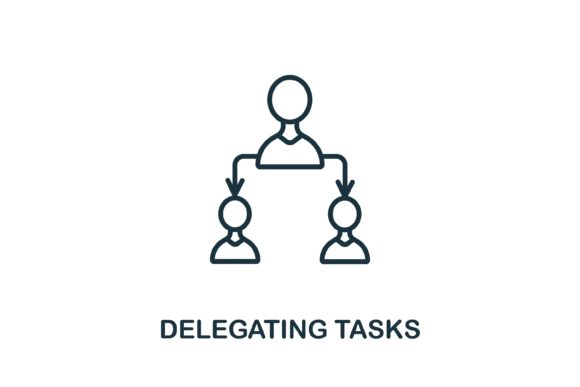
Visual tools like the Delegating Tasks icon from the production management collection serve as powerful aids in communicating complex ideas simply and clearly. Whether used in templates, web design, or infographics, this icon represents the concept of distributing work efficiently and strategically.
The icon’s clean, simple line style makes it versatile for a variety of applications, including presentations, digital dashboards, and internal training materials. Its availability in both EPS and JPG formats ensures that it can be easily edited and integrated into different design workflows.
For marketers, educators, and business leaders, incorporating visual elements like the Delegating Tasks icon into your communication materials helps reinforce the importance of delegation as a core operational strategy.
Conclusion: Delegating Tasks as a Strategic Habit
Mastering the art of delegation doesn’t happen overnight, but with consistent effort and intention, it becomes a strategic habit that transforms how you lead and work. Delegating tasks isn’t about giving up control—it’s about exercising control in a smarter, more sustainable way.
Whether you're building a brand, managing a team, or scaling a business, the ability to delegate effectively will always be a key differentiator. Start small, stay intentional, and watch how strategic delegation unlocks new levels of productivity, creativity, and growth.